





- Project Objective: Apply AI/IoT-based smart technologies to social welfare facilities to improve the quality of care services, and lay the groundwork for field-ready service demonstration and commercialization.
- Participating & Demonstration Institutions: Ministry of Health and Welfare; Korea Central Public Agency for Social Service (KCPASS); People&Technology (Lead Institution); Eden T&S; Hahaeho; Cleverus; Glocare; Bigwave Robotics; National Health Insurance Service Ilsan Hospital; Kyung Hee University; Korea University Industry-Academic Cooperation Foundation; Cheongam College Industry-Academic Cooperation Foundation.
- Field Demonstration Sites: National Health Insurance Service Seoul Nursing Home; Suwon Municipal Nursing Home for the Elderly.
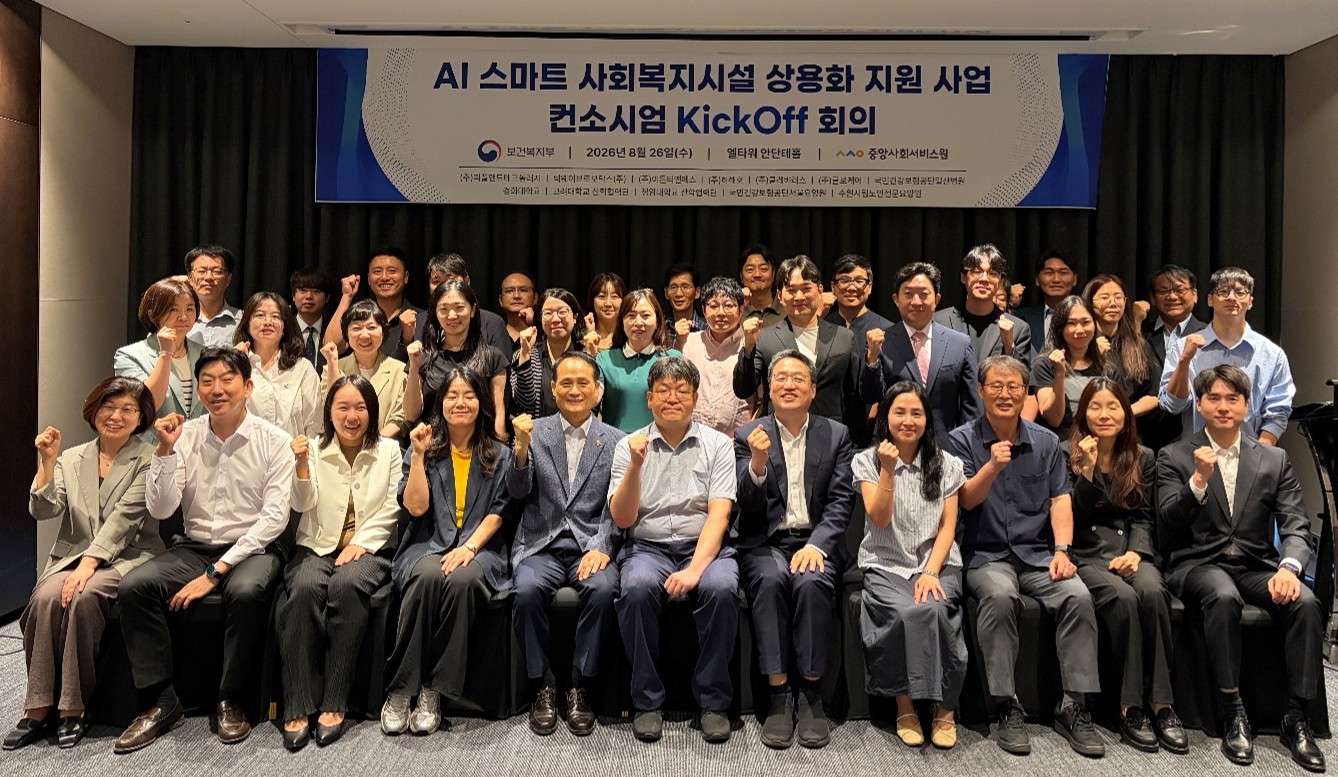
The kickoff meeting for the 'AI Smart Social Welfare Facility Commercialization Support Project' consortium was held on August 26 at Andante Hall, L-TOWER, in Seocho-gu, Seoul.
The project aims to apply AI- and IoT-based smart technologies to social welfare facilities to improve the quality of care services, advance the demonstration of field-ready services, and lay the groundwork for their commercialization.
The meeting was attended by the Ministry of Health and Welfare and the Korea Central Public Agency for Social Service (KCPASS), along with consortium member institutions including lead institution People&Technology, Eden T&S, Hahaeho, Cleverus, Glocare, Bigwave Robotics, National Health Insurance Service Ilsan Hospital, Kyung Hee University, Korea University Industry-Academic Cooperation Foundation, and Cheongam College Industry-Academic Cooperation Foundation. National Health Insurance Service Seoul Nursing Home and Suwon Municipal Nursing Home for the Elderly also took part as field demonstration institutions, joining the discussion on how technologies would be applied and validated in real social welfare settings.
The meeting opened with introductions of the participating institutions and welcoming remarks, followed by kickoff presentations centered on each institution's role and applied technologies, and a review of the project's progress to date and its future plans. This was followed by an overview of project operations and budget execution procedures, along with an open discussion on the services and technology applications to be prioritized during the upcoming living-lab demonstration process.
Participating institutions agreed that addressing the challenges facing the social welfare field, including an aging population and a shortage of care workers, requires going beyond the simple introduction of individual technologies, and instead connecting them into services that can actually be used in real care settings. They also agreed to organically link the technologies and expertise held by each institution to improve field applicability and service completeness.
Seo Min-su, Director at the Ministry of Health and Welfare, said, "As the aging population grows and the shortage of care workers deepens, we will actively support this project so that AI and smart technologies can become a practical solution for the social welfare field."
Park Seon-jeong, General Manager at the Korea Central Public Agency for Social Service (KCPASS), stated, "We will faithfully carry out our role of connecting institutions and the field, so that participating institutions with diverse technologies and expertise can cooperate smoothly under a shared project goal, and so that the technologies developed can be effectively applied in real-world settings."
Through this kickoff meeting, the consortium clarified the roles, scope of work, and future direction for each participating institution, laying a systematic foundation for carrying out the project.
Going forward, participating institutions plan to continuously share progress on the project and its field demonstrations, and to actively incorporate feedback from the demonstration institutions to validate the applicability and usability of the services. Through this process, the consortium aims to build a model in which AI and smart technologies can make a substantive contribution to improving the care environment at social welfare facilities, and to establish, step by step, the foundation needed for future field expansion and commercialization.

