





- AI Assistant for Disease Control: A conversational AI service that provides answers grounded in reliable infectious disease information.
- AI Infectious Disease Risk Assessment: An automated evaluation system that analyzes the risk of emerging and resurgent infectious diseases without deviation.
- AI-Enhanced Epidemiological Investigation: An AI-based analysis and detection system that proactively identifies contact networks and cluster outbreaks.
Efforts to integrate AI into every stage of infectious disease response, from information provision to risk assessment and contact tracing, are gaining momentum in earnest. At the center of this movement is the Infectious Disease Response Subcommittee of the "Public AX Project," led by the Ministry of Science and ICT and the National IT Industry Promotion Agency (NIPA).
A consortium of People&Technology (CEO Seongpyo Hong) and DearSoft (CEO Jaeseok Shim) announced that, through the "AI Solution Development and Field Trial Project for Infectious Disease Response for a Healthier Tomorrow" under the Public AX Project, it has developed three AI services supporting the full scope of infectious disease management, including the conversational "AI Assistant for Disease Control," "AI Infectious Disease Risk Assessment," and "AI-Enhanced Epidemiological Investigation" (transmission network and cluster outbreak detection), and is currently conducting field trials to validate their use in real-world operations.
AI Assistant for Disease Control: Evidence-Based Conversational AI Specialized in Infectious Diseases
The "AI Assistant for Disease Control" is a conversational AI that answers questions on infectious disease management and vaccination based on official materials from the Korea Disease Control and Prevention Agency (KDCA), including guidelines, regulations, and statistics, while clearly citing its sources. Built on RAG technology and a proprietary embedding model specialized for the infectious disease and medical field, it goes beyond simple document retrieval, independently looking up the statistics and institutional information it needs and incorporating them into its answers. It also maintains context across multiple turns of conversation, allowing it to sustain a consistent flow of responses even as users ask follow-up questions.
This marks a clear point of differentiation from general-purpose large language models (LLMs). While general-purpose LLMs excel at generating natural sentences, they struggle to cite sources or evidence for their answers and are slow to reflect the latest developments. The "AI Assistant for Disease Control," by contrast, generates responses based on accurate, up-to-date infectious disease information, including KDCA regulations, guidelines, and press releases, setting it apart with highly reliable, expert-level answers.
The first-phase trial examined the quality of responses to actual user questions. Starting in August 2026, a second-phase usability trial will verify field applicability based on real work scenarios, covering seven tasks across eight job functions.
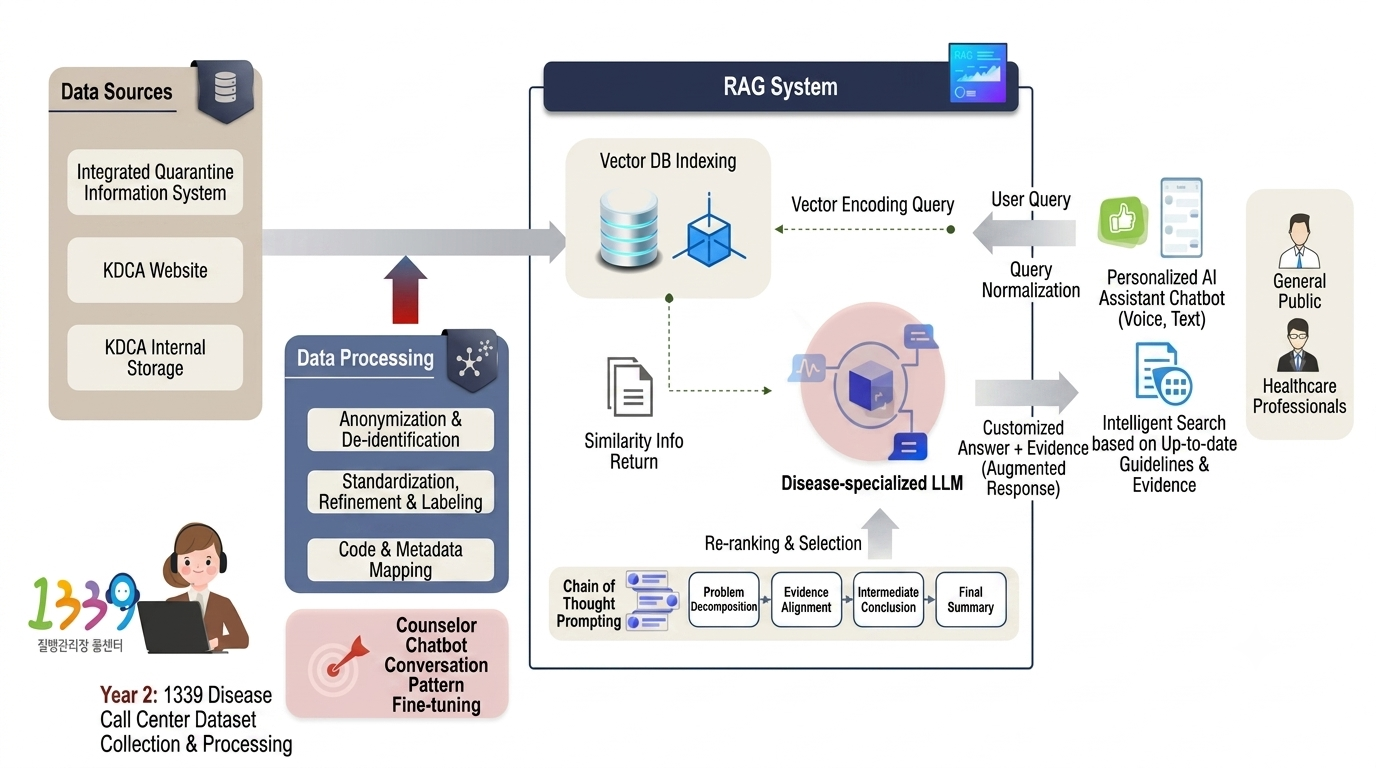
Service architecture of the RAG-based AI Assistant for Disease Control.
AI Infectious Disease Risk Assessment: Automated Risk Assessment Based on Multi-AI Cross-Validation
AI Infectious Disease Risk Assessment addresses a highly demanding task: rapidly judging the quality of evidence from domestic and international papers, reports, and news to calculate and report risk levels. This work has traditionally relied on the experience and manual effort of epidemiological investigators, leading to variation in results depending on the assessor. To minimize this variation, the risk assessment system applies a multi-AI ensemble structure in which four AI models conduct independent assessments, after which discrepancies and contradictions are detected and reconciled. Using explainable AI (XAI), the system presents its reasoning in an interpretable form, which epidemiological investigators then review to reach a final assessment.
In the first-phase trial conducted in June 2026, AI risk assessment results were compared against the judgments of epidemiological investigators for two diseases, measles and MERS, and the two matched completely in every case. In these cases, assessment time was also reduced from 72 hours to roughly 8 hours, a reduction of about 89%. However, as this is an early-stage trial limited to two diseases, further validation is planned through a second-phase trial and certified performance testing.
Going forward, the plan is to refine the evaluation metrics and, following the second-phase trial and certified performance testing, consider transitioning the system into a formal service.
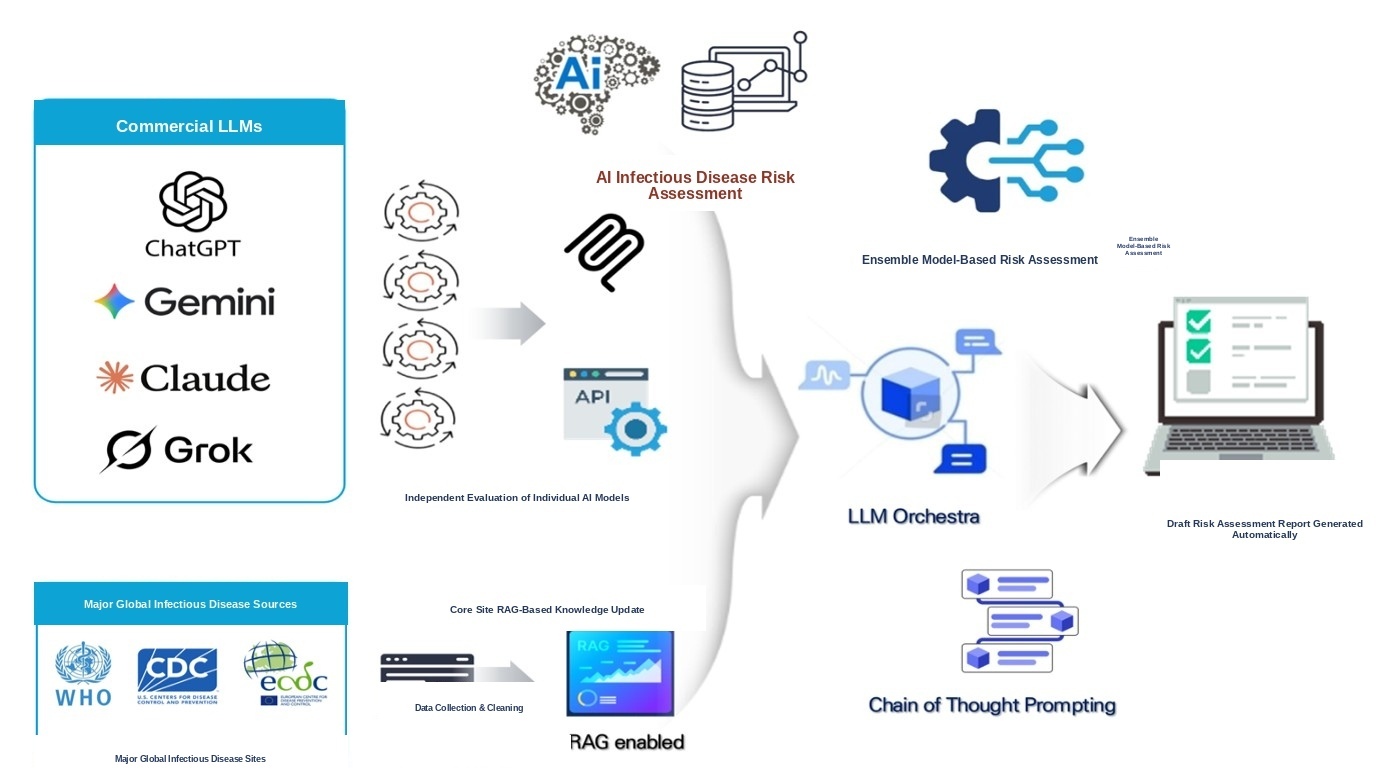
Service architecture of AI Infectious Disease Risk Assessment.
AI-Enhanced Epidemiological Investigation: Detecting Transmission Networks and Signs of Cluster Outbreaks
The AI-Enhanced Epidemiological Investigation system uses the following two functions to rapidly identify contact relationships when an infectious disease occurs and to detect early signs of cluster outbreaks in advance.
The "N-Degree Network" function uses test data from the KDCA's Integrated Quarantine Information System, covering case reports, epidemiological investigations, and contact management, within a linked environment built for the trial, automatically generating transmission pathways based on time and location factors. This allows the network of confirmed cases and their contacts to be expanded step by step, visualizing cluster outbreaks and transmission routes at a glance.
In addition, the "Cluster Outbreak Anomaly Detection" function uses AI to analyze data from large numbers of confirmed cases and contacts, automatically identifying groups likely to belong to the same chain of transmission. Combined, these two functions enable a shift away from the traditional reactive approach, in which cluster outbreak investigations begin only after a report is filed and at the discretion of an epidemiological investigator, toward a proactive response that can act even before a report is made.
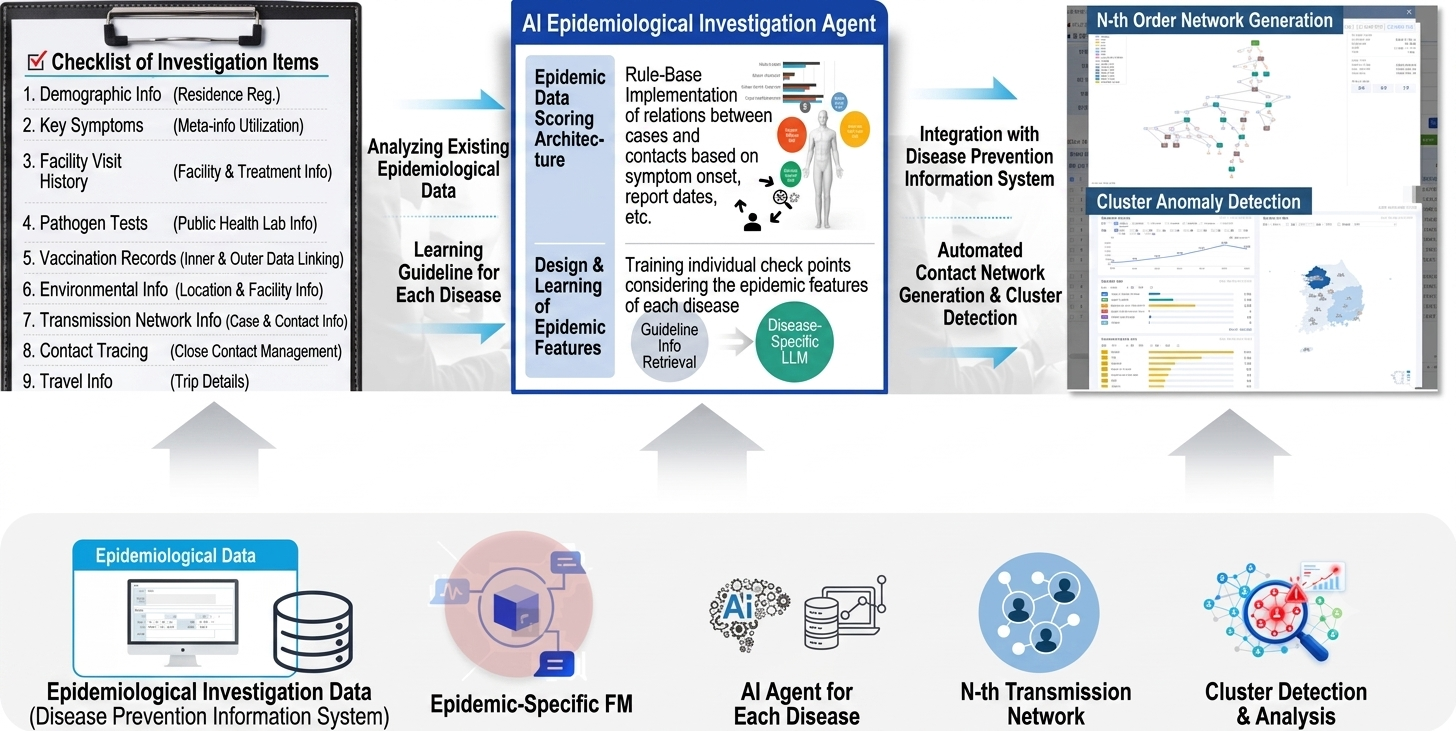
Functional overview of the AI-Enhanced Epidemiological Investigation system.
The People&Technology and DearSoft consortium is conducting the trials within the KDCA's actual operational environment, progressively validating the system's performance and stability. Based on the trial results, the consortium plans to continue working with the KDCA to refine the service and pursue its transition into a formal, fully operational service.

