





PnT Builds Real-Time Patient Monitoring System at Chonnam National University Hospital
- AuthorKim Sunae
- DateJun 10, 2026
- Views573
People & Technology Builds Real-Time Patient Monitoring System at Chonnam National University Hospital
— Noted as a large-scale smart ward implementation leading the digital transformation of national/public tertiary hospitals —
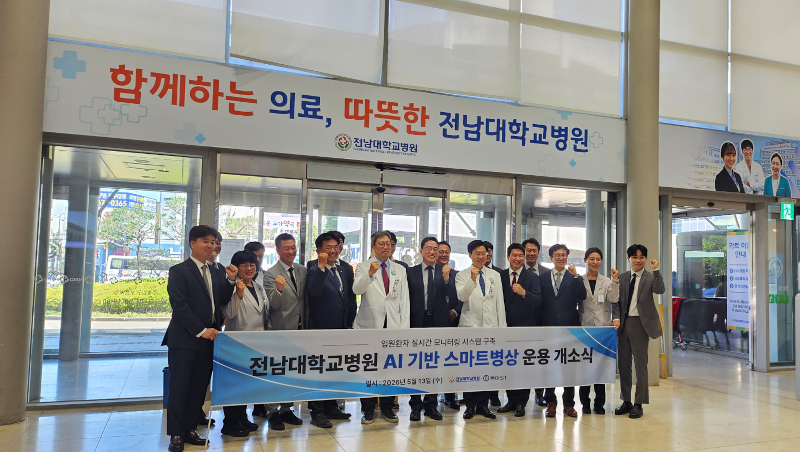
On the 13th, People & Technology CEO Hong Sung-pyo and company representatives pose for a commemorative photo at the 'AI Smart Monitoring System Inauguration Ceremony' at Chonnam National University Hospital.
People & Technology (CEO Hong Sung-pyo), a smart hospital service platform company specializing in medical AX·DX, announced that it has built an AI-based real-time patient monitoring system at Chonnam National University Hospital, holding an inauguration ceremony on the 13th.
This project is part of the government's initiative to build AI-based medical systems targeting regional responsible medical institutions such as national university hospitals, with the goals of strengthening patient safety, improving medical staff efficiency, and enhancing the quality of regional healthcare. People & Technology deployed the real-time smart patient monitoring system across a total of 236 beds in key departments including neurosurgery, thoracic surgery, plastic surgery, orthopedics, anesthesiology & pain medicine, general surgery, and pulmonology.
The inauguration ceremony was held on May 13 at the conference hall of Chonnam National University Hospital's Biomedical Research Support Center. Attendees included CEO Hong Sung-pyo of People & Technology, representatives from partner companies Meju and Dong-A ST, and key medical staff from the hospital. The event proceeded in order: introduction of guests, hospital director's address, partner company congratulatory remarks, project introduction, ribbon-cutting, and ward rounding.
Hospital Director Jeong Shin stated: "The deployment of the AI smart monitoring system marks an important starting point for Chonnam National University Hospital's leap toward becoming an AI-based smart hospital," adding, "We will build a smart future model for regional healthcare by providing patients with a safer inpatient environment and medical staff with a more efficient care environment."
People & Technology was responsible for building the real-time patient monitoring system for this project. When a patient wears the patch-type ECG wearable device 'Hicardi,' vital signs are collected in real time, and the Smart ID Card (bed information display) installed in the patient room acts as a gateway, transmitting the data to the IndoorPlus+ SmartCare platform. The collected data is automatically linked with the hospital's EMR through the platform, providing an integrated management environment where nursing station monitors can track patient status in real time.
The Smart ID Card also integrates with the Hospital Information System (HIS) to automatically update patient admission and discharge information, converting bed information management from manual to digital — reducing administrative burden on nursing staff and enabling real-time awareness of bed status. The Hicardi device can be used continuously for up to 3 days on a single 1-hour charge, has a high waterproof rating allowing use during showers, and qualifies for ECG monitoring reimbursement codes (E6544) and remote cardiac monitoring codes (EX871).
This Chonnam National University Hospital implementation is drawing attention as a large-scale case demonstrating the IndoorPlus+ SmartCare platform's expanding reach across both tertiary hospitals and public medical centers. People & Technology plans to continue driving meaningful change across more hospital environments going forward.
CEO Hong Sung-pyo commented: "This Chonnam National University Hospital deployment is a meaningful case leading the AI-based smart hospital transformation of national and public tertiary hospitals," adding, "We will continue working with more medical institutions to realize patient safety and improved efficiency for medical staff."

